Press Release - Saint Francis University Develops Hong Kong's First Localised WHO Disability Assessment Tool Partners with Christian Family Service Centre to Help Persons in Rehabilitation Live More Independently 2026-09-25
Saint Francis University Develops Hong Kong's First Localised WHO Disability Assessment Tool Partners with Christian Family Service Centre to Help Persons in Rehabilitation Live More Independently
25 Sep 2026
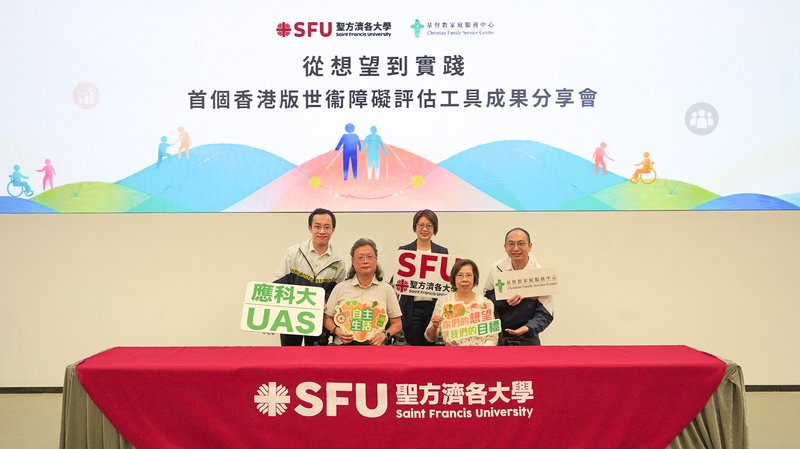
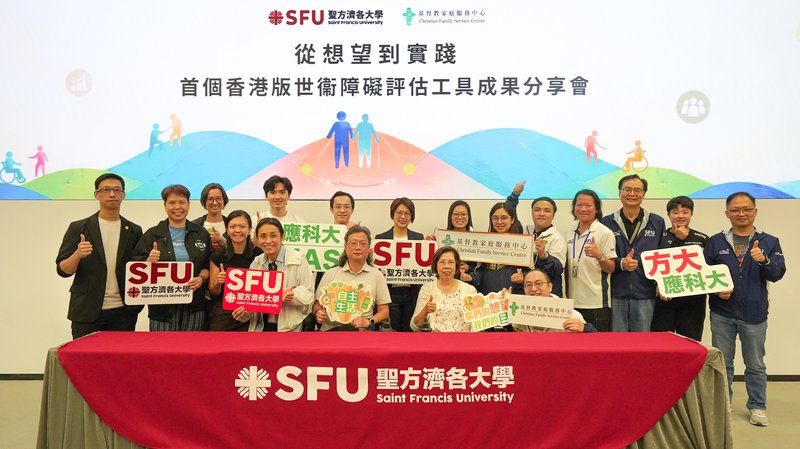
Saint Francis University (SFU), in collaboration with the Christian Family Service Centre (CFSC), has successfully developed and validated Hong Kong's first "WHO Disability Assessment Schedule 2.0 Traditional Chinese (Hong Kong) Version" (WHODAS 2.0 TC-HK). Led by Dr Tiffany Choi Ching-man, Associate Professor of Practice at SFU's S.K. Yee School of Health Sciences, the research team designed the instrument specifically for Hong Kong's community rehabilitation services.
This study provides healthcare and rehabilitation professionals in Hong Kong a standardised assessment method, enabling them to assess holistically the daily functioning, social participation and support needs of persons with disabilities in community care. The findings were published in the international academic journal PLOS ONE in August 2026. They also align with the policy direction of recent Policy Addresses, including continued expansion of rehabilitation service places and the phased establishment of "Integrated Community Rehabilitation Centres" to deliver targeted support.
The World Health Organisation launched "WHO Disability Assessment Schedule" (WHODAS 2.0) In 2010, based on the International Classification of Functioning, Disability and Health (ICF), to measure how health conditions affect everyday life. Earlier Chinese versions differed markedly in wording from Hong Kong's linguistic context and socio-cultural environment, and Hong Kong's healthcare and social welfare sectors had long lacked a rigorously validated Chinese assessment tool suitable for local use. In response, SFU's research team translated the original tool into the local context, with review by interdisciplinary healthcare and linguistic experts to ensure that the wording and content of the assessment questionnaire fit Hong Kong's community life situations.
SFU's research team collaborated with CFSC and, between January 2023 and December 2024, invited 177 persons with disabilities from four government-subvented community rehabilitation units to take part in the study. Participants included people with physical disability, hearing impairment, visual impairment, mental illness and intellectual disability. Using the six domains of WHODAS 2.0 TC-HK, the study examined disability and actual rehabilitation needs arising from illness or other short- or long-term health conditions. The 36-item questionnaire uses the past 30 days as the reference period, with answers on a five-point scale from "no difficulty" to "extreme difficulty", and can be completed in 5 to 20 minutes.
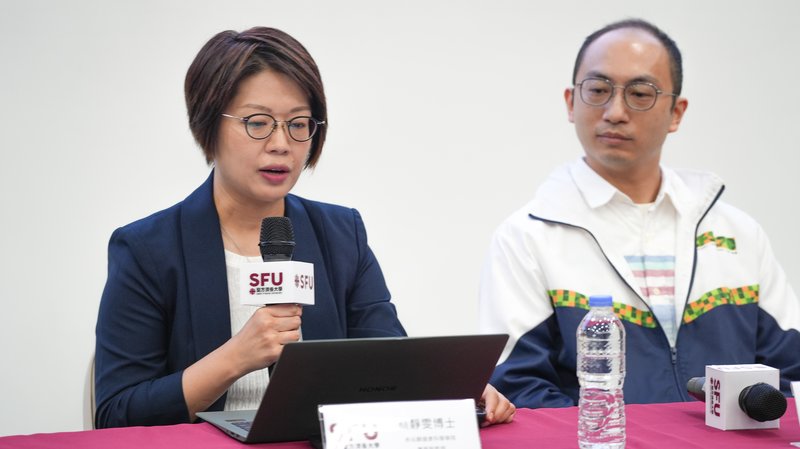
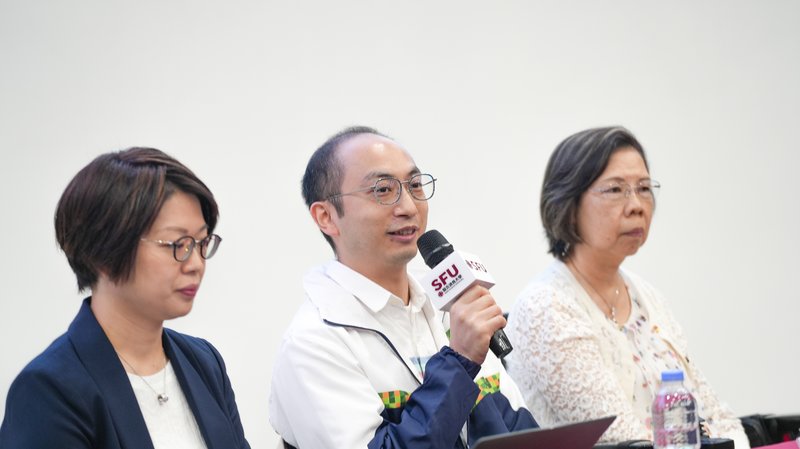
Dr Choi of SFU said, "Unlike traditional tools that focus mainly on physical function, WHODAS 2.0 TC-HK more fully covers daily activities, self-care, relationships and social participation. In 5 to 20 minutes it produces a standardised disability level and profile. It can be used in both clinical and general population settings and matches the practical needs of community rehabilitation in Hong Kong."
Ms. Pandora Wang Chao-ming, Programme Director (Community Support Services for Persons with Disabilities) of CFSC, said, "As the collaborating service organisation, we are delighted to have taken part in this study. The tool is already being piloted in our day-to-day services. Centred on service users' aspirations, it helps our multidisciplinary colleagues understand their life challenges more clearly, design more precise interventions, support recovery and restore hope."
The latest Policy Address proposes increasing rehabilitation service places and establishing a "Welfare Information Sharing E-platform." As early as 2024, the Government also announced multiple measures to strengthen support for persons with disabilities, including establishing 14 "Integrated Community Rehabilitation Centres" across Hong Kong in phases, increasing 1,280 service places, creating 90 peer support worker positions, and setting up a district support centre for persons with disabilities in New Territories East, with the goal of increasing the total number of rehabilitation service places to about 39,900 by or before the 2028-29 financial year.
The research team pointed out that WHODAS 2.0 TC-HK is precisely a standardised assessment tool that can support the implementation of the above policies. Through this assessment questionnaire, frontline teams can systematically assess service users' specific difficulties across six life domains, providing an objective data basis for case management and helping "Integrated Community Rehabilitation Centres" allocate service resources more precisely, thereby putting the people-oriented philosophy of rehabilitation services into practice.
One of the service users, Mr Ho, lives with chronic demyelinating neuritis and had long found daily life and social participation constrained., The multidisciplinary team worked with him on a personalised rehabilitation plan based on his WHODAS 2.0 assessment. After more than a year of support and his own efforts, his recovery improved markedly. Mr Ho said, "Earlier assessments often focused only on physical impairment. WHODAS 2.0 reflects my real needs in daily living, communication, mobility and community participation. My physical function and self-care have improved, but more importantly I have regained confidence and a sense of control, and can take part in society again and live more independently."
Another service user, 73-year-old Ms Lai, was fully paralysed in 2014 and had a further mild stroke in 2024, alongside high cholesterol, hypertension and osteoporosis. Guided by her WHODAS 2.0 results, CSFC team tailored her rehabilitation, and after nearly two years her mobility impairment score had fallen from 75 to 56. She said, "Having gone through two strokes and cancer, even dressing, reaching for things or walking was a struggle at first. Thankfully the team used WHODAS 2.0 not only to look at my pain or the after-effects of paralysis, but also to assess in detail my day-to-day living and social needs. Step by step I practised moving from a quadruped stick to a walking stick. I now walk more steadily, feel more cheerful, and have regained the confidence to look after myself and go out to meet people."
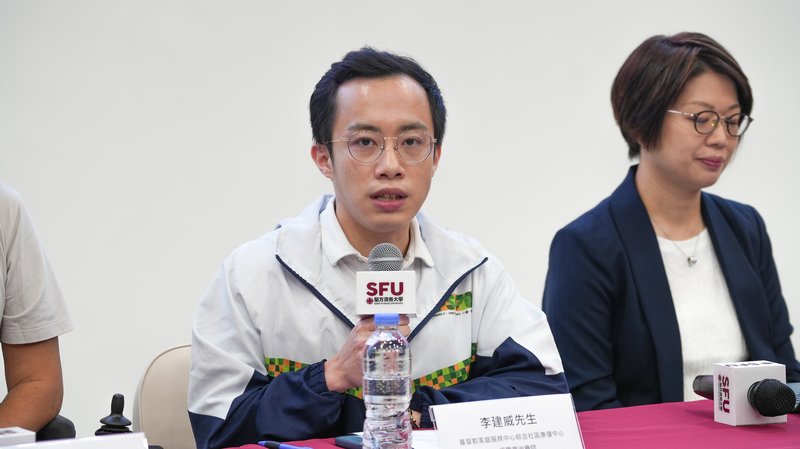
The research is also driving multidisciplinary collaboration. An occupational therapist from an Integrated Community Rehabilitation Centre (ICRC) shared clinical experience of using WHODAS 2.0. Mr Li Kin Wai, Occupational Therapist I, said, "WHODAS 2.0 TC-HK helps multidisciplinary teams understand service users' real functional limitations in daily life, rather than relying only on a medical diagnosis. Teams can set clinical goals more precisely and measure progress objectively." He added that the tool gives social workers, therapists, nurses and others a shared language, improving collaboration and communication and enabling more comprehensive, appropriate support.
The research team hopes the tool will bring systemic improvement to community rehabilitation in Hong Kong: common assessment standards across organisations, objective measurement of outcomes, closer collaboration between health and social care, and personalised, user-centred plans. Over time, the data collected should also inform government and provider decisions on resource allocation, service planning and policy review.
The paper has been published in the international academic journal PLOS ONE, underscoring SFU's contribution to local healthcare research in Hong Kong. The study also supports community rehabilitation practice, disability inclusion, a people-oriented care model, and collaboration between academia and community service organisations.