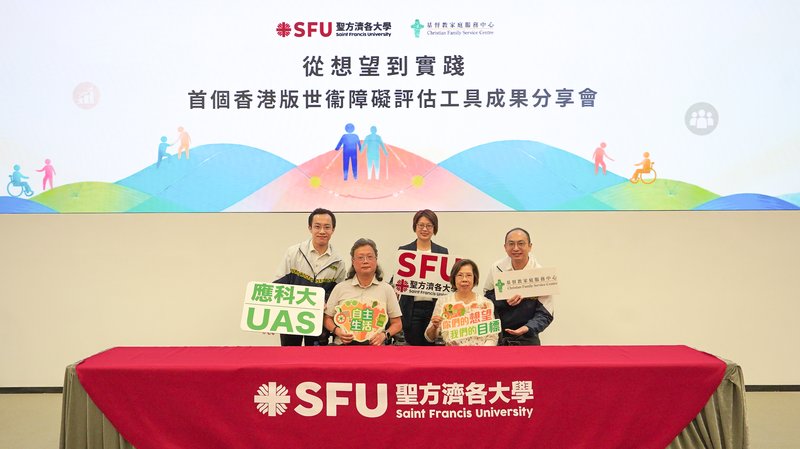
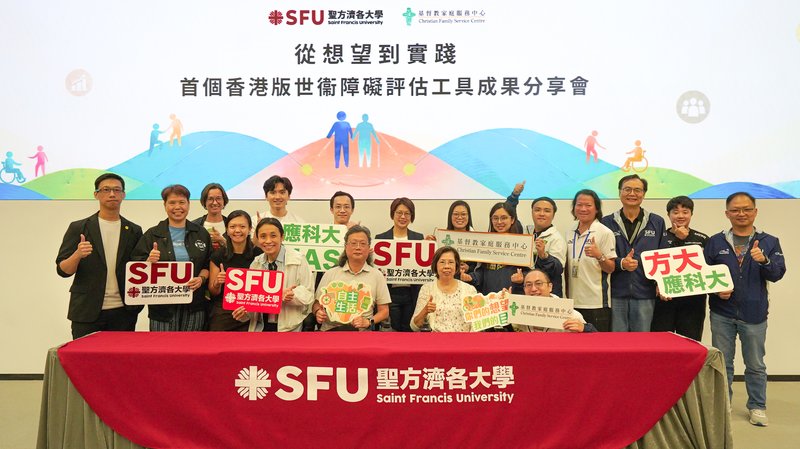
Saint Francis University (SFU), in collaboration with the Christian Family Service Centre (CFSC), has successfully developed and validated Hong Kong's first "WHO Disability Assessment Schedule 2.0 Traditional Chinese (Hong Kong) Version" (WHODAS 2.0 TC-HK), designed specifically for community rehabilitation services. Led by Dr Tiffany Choi Ching-man, Associate Professor of Practice at SFU's S.K. Yee School of Health Sciences, the research provides healthcare and rehabilitation professionals in Hong Kong with a standardised assessment tool tailored to the city's linguistic and socio-cultural context. The findings were published in the international academic journal PLOS ONE in August 2026.
WHODAS 2.0 was developed by the World Health Organization based on the International Classification of Functioning, Disability and Health (ICF) framework to assess how health conditions affect everyday functioning. In response to the limitations of earlier Chinese versions, which did not fully reflect Hong Kong's local context, SFU's research team translated and localised the instrument, with review by interdisciplinary healthcare and linguistic experts, to ensure that its wording and content would meet the practical needs of community rehabilitation services in Hong Kong. The study also involved 177 persons with disabilities from four government-subvented community rehabilitation units, covering different disability groups, to validate the tool's local applicability.
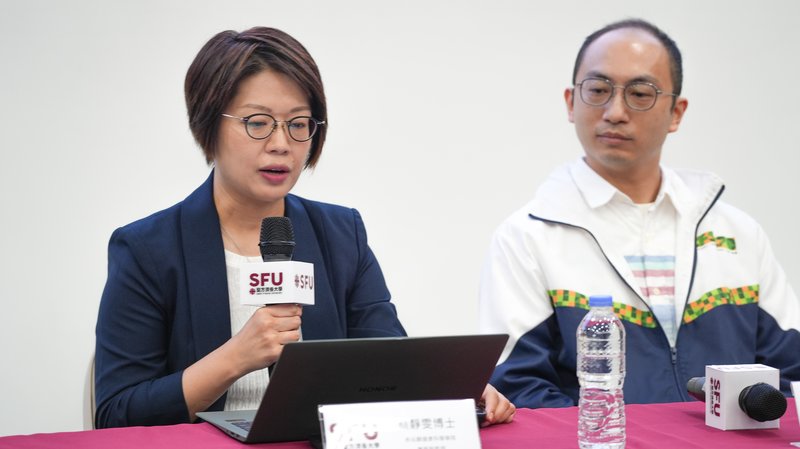
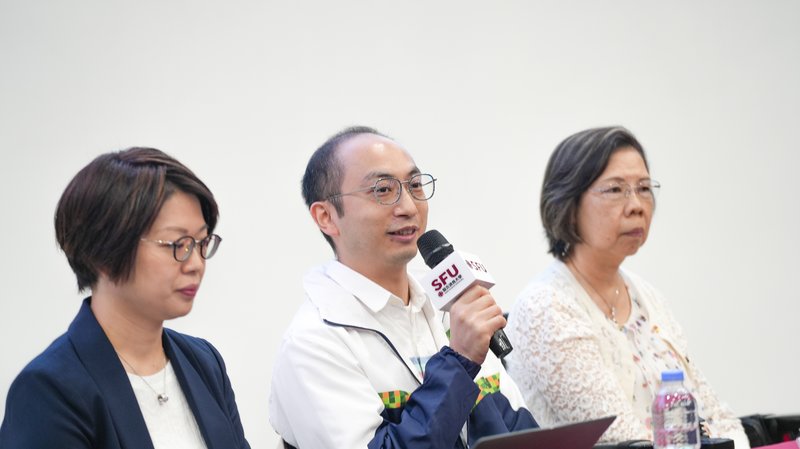
Dr Choi of SFU said, "Unlike traditional tools that focus mainly on physical function, WHODAS 2.0 TC-HK more fully covers daily activities, self-care, relationships and social participation. It can be used in both clinical and general population settings and matches the practical needs of community rehabilitation in Hong Kong."
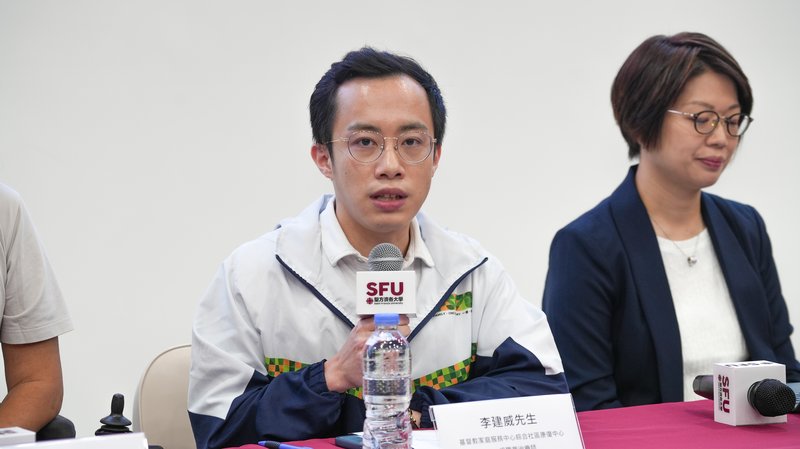
Ms Pandora Wang Chao-ming, Service Director of CFSC, said, "The tool is already being piloted in our day-to-day services. Centred on service users' aspirations, it helps our multidisciplinary colleagues understand their life challenges more clearly and design more targeted intervention plans, supporting service users' recovery and bringing hope to their lives."
The research team hopes the tool will bring systemic improvement to community rehabilitation services in Hong Kong, including common assessment standards across organisations, objective measurement of rehabilitation outcomes, closer collaboration between healthcare and social welfare professionals, and support for personalised, service user-centred rehabilitation plans.
The study demonstrates SFU's contribution to healthcare research in Hong Kong, while supporting community rehabilitation practice, disability inclusion, people-centred care, and collaboration between academia and community service organisations.