Research Highlights
Research Highlights
Dynamic stability monitoring and control of construction tower cranes using Digital Triple AI and IoT
Update as of 3 August 2026
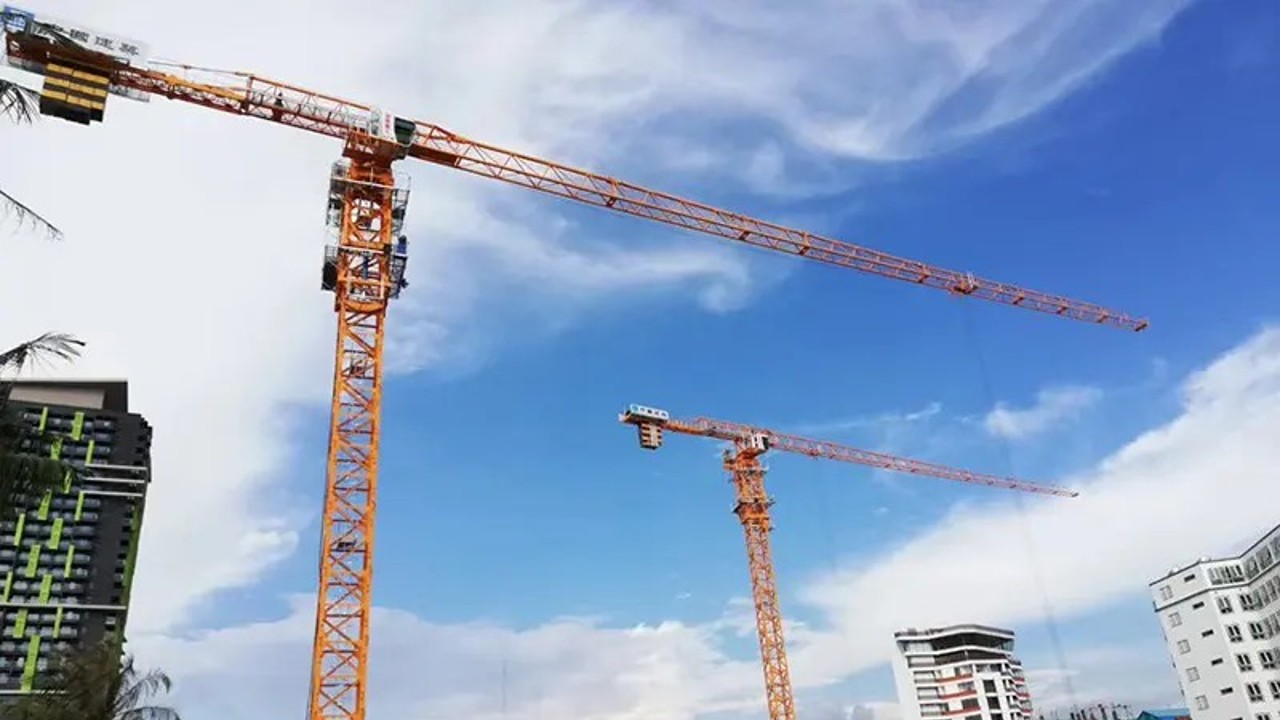
Digital twin technologies are increasingly adopted for monitoring engineering structures; however, they often overlook critical life-cycle effects such as ageing, damage, and fatigue. In addition, acquiring representative damaged data from real structures is costly and impractical, while purely simulated data remains challenging to validate. These limitations restrict the development of reliable artificial intelligence (AI) models for structural health assessment.
A novel “digital triple AI” methodology is proposed to address these challenges, demonstrated using a construction tower crane. The framework integrates three interconnected components: the full-scale crane, a dynamically scaled physical prototype, and their corresponding digital models. High-fidelity finite element models are developed using drone-based LiDAR data and material characterization to identify key dynamic properties. A 1:50 scale prototype is constructed based on dynamic similarity principles to ensure consistency in modal behaviour and scaling relationships.
The prototype is extensively instrumented to collect time-history responses under simulated ageing and damage conditions. Wavelet-based processing is applied for feature extraction and AI training, enabling structural condition identification from accelerometer signals. Both quasi-static and dynamic AI models are developed. The trained models are subsequently scaled to full-size structures, and a variable-stiffness tuned mass damper is introduced to reduce vibration and extend service life.
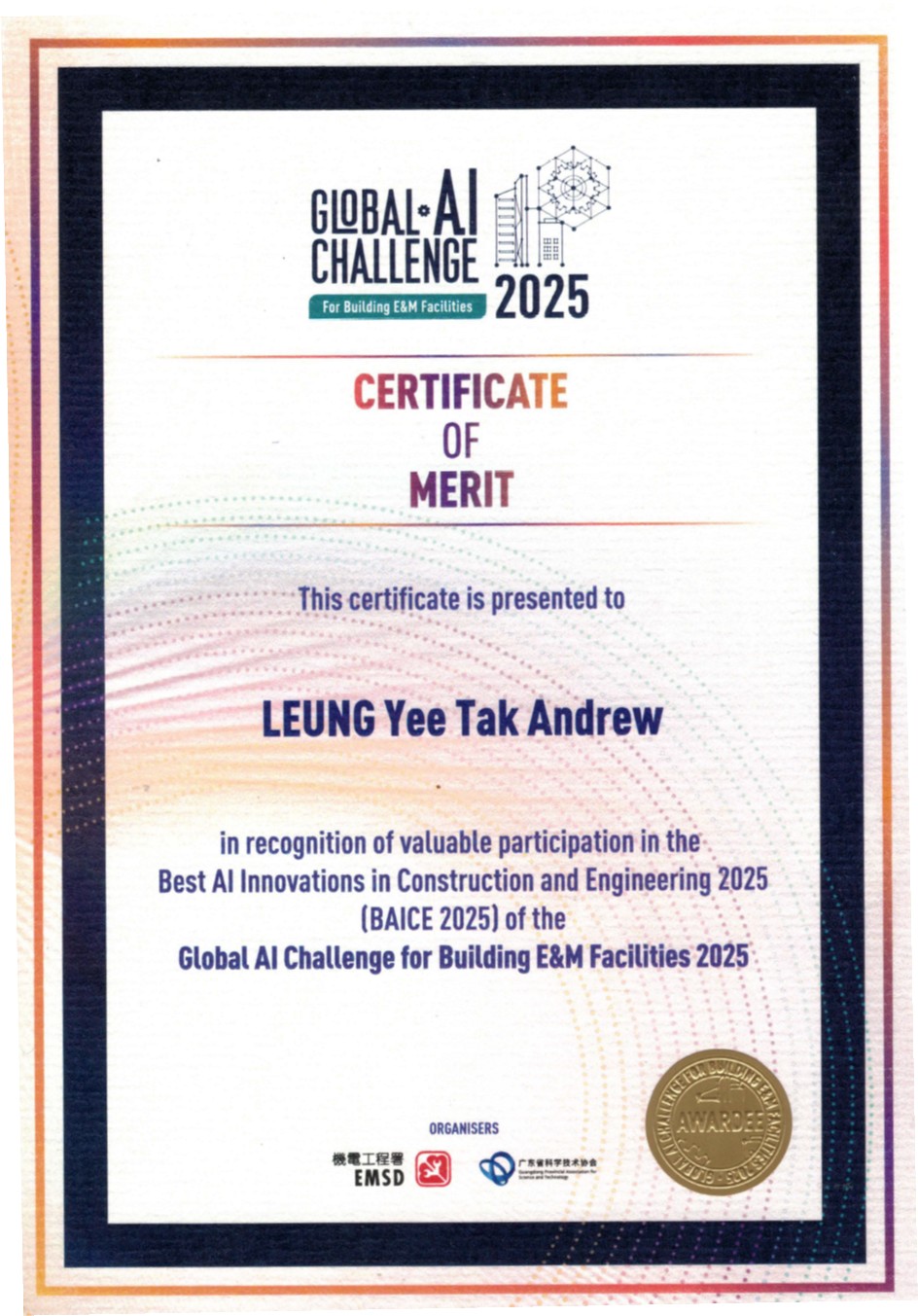
A Certificate of Merit at the Global AI Challenge 2025 was awarded.
Team Members:
- PI: Prof. LEUNG Yee Tak Andrew, Yam Pak Charitable Foundation School of Computing and Information Sciences, Saint Francis University
- Ir Dr. WONG Ho-fai Simon, Dept. of Construction, Environment and Engineering, Technological and Higher Education Institute of Hong Kong
- Dr. HUNG King-fai Keven, Electronic Engineering and Computer Science, Hong Kong Metropolitan University
- Dr. HANG Ching Nam, Yam Pak Charitable Foundation School of Computing and Information Sciences, Saint Francis University
- Dr. TONG Catherine, Mathematical Physical and Life Sciences Division, University of Oxford
- Prof. LIM Chi Wah, Dept. of Architecture and Civil Engineering, City University of Hong Kong
Reference no.: UGC/IDS(C)11/E01/24